Finding the best Titleist golf balls for your game can feel overwhelming. You walk into a pro shop and see the wall of white boxes—Pro V1, AVX, Velocity, Tour Soft—and the paralysis sets in. The truth is, the best ball isn’t necessarily the one the pros play on Sunday. It’s the one that complements your swing speed, your typical ball flight, and your strategy for scoring.
This guide cuts through the noise. We’ll break down each model with a practical focus, helping you match Titleist’s world-class engineering to your actual on-course needs.
At a Glance: Your Quick Guide to Choosing
- Understand the Two Cover Types: Learn the crucial difference between urethane (Pro V1 family for max control) and ionomer (all others for distance and durability).
- Match the Ball to Your Game: We’ll map each Titleist model to a specific player profile, from high-speed, low-handicappers to beginners seeking feel and forgiveness.
- Decode the Pro V1 Family: Finally understand the real-world differences between Pro V1, Pro V1x, AVX, and the niche Pro V1x Left Dash.
- A Simple 3-Step Fitting Process: Get a practical framework to test and confirm the perfect ball for your swing.
- Answer Your Biggest Questions: We’ll tackle common misconceptions about swing speed, price, and which ball is right for seniors or high handicappers.
The Titleist Philosophy: Why the Right Ball Matters
Titleist has earned its reputation as the #1 ball in golf through relentless consistency and advanced technology. At the heart of their design are multi-layer cores for efficient energy transfer (distance) and sophisticated dimple patterns that stabilize flight by reducing drag. But the most significant differentiator in their lineup is the cover material.
Think of it this way:
- Urethane Covers (Pro V1 Family): This is a softer, premium material. It allows the grooves on your wedges and short irons to “grab” the ball more effectively, creating significantly higher spin on approach shots. This is the “hop-and-stop” control you see from professionals.
- Ionomer Covers (Tour Soft, Velocity, TruFeel): This is a firmer, more durable material. It’s fantastic for maximizing distance and reducing spin off the driver, which can help straighten out a slice or hook. On the greens, these balls tend to “release” and roll out more on chips and pitches.
Understanding this single concept is the first step in narrowing your choice. Before diving into specific models, getting a feel for the brand’s overall mission can provide valuable context. Are Titleist Balls Right For You? This overview helps frame why their commitment to quality resonates with so many golfers.
The Pro V1 Family: Choosing Your Tour-Level Weapon
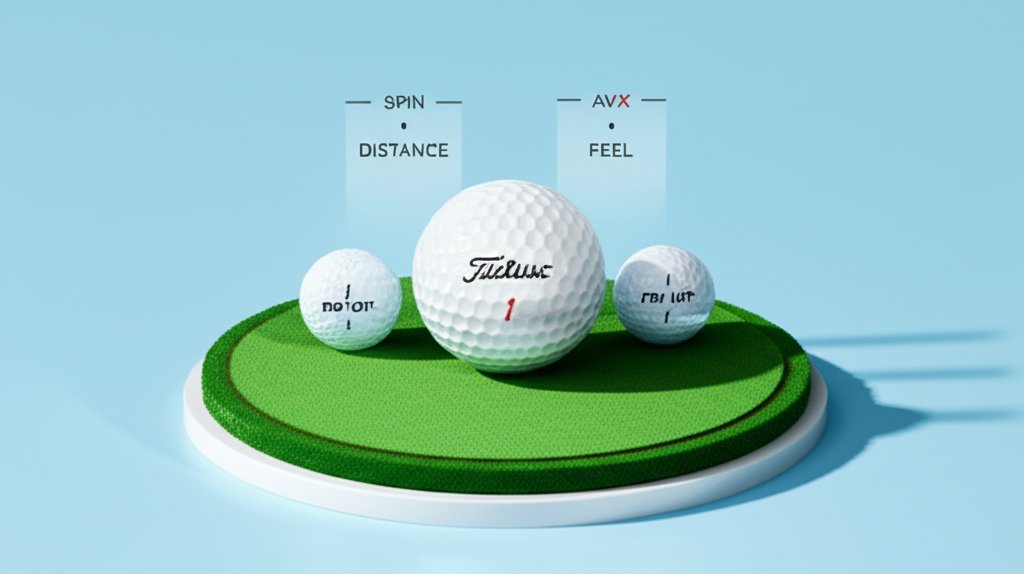
This is the flagship lineup, built with urethane covers for golfers who demand the highest level of performance from tee to green. Choosing between them isn’t about which is “better,” but which is better for you.
Pro V1: The Gold Standard for All-Around Performance
The Pro V1 is the benchmark for a reason. It offers a masterful blend of long, consistent distance off the tee, a penetrating mid-level flight, and exceptional “drop-and-stop” control into the greens. Its softer feel is preferred by a wide range of players.
- Who It’s For: The golfer who wants balanced performance without sacrificing any one attribute. If you don’t have a glaring issue you’re trying to fix (like excessively high spin or a low launch), the Pro V1 is an incredible place to start.
- Ideal Swing Speed: 98-110 mph
- Key Characteristics: Soft feel, mid-flight, low long-game spin, high short-game spin.
Pro V1x: For Higher Flight and More Greenside Spin
Compared to the Pro V1, the Pro V1x is designed to fly higher and spin more with irons and wedges. It also has a slightly firmer feel off the clubface. This combination is ideal for players who need help getting the ball up in theair or want maximum stopping power on firm greens.
- Who It’s For: Players seeking a higher trajectory and maximum short-game spin. It’s often favored by high-speed swingers who can activate its firm core for more distance.
- Ideal Swing Speed: 105+ mph
- Key Characteristics: Firmer feel, high flight, mid long-game spin, highest short-game spin.
AVX: The Low-Spinning Distance Alternative
The AVX is the softest-feeling and lowest-spinning ball in the Pro V1 family. It was engineered for golfers who want a premium tour ball but generate too much spin with the driver. Its lower, piercing ball flight is also a massive advantage in windy conditions.
- Who It’s For: Golfers who prioritize a very soft feel and need to reduce driver spin to maximize distance or find more fairways.
- Ideal Swing Speed: 90-105 mph
- Key Characteristics: Very soft feel, low flight, lowest long-game spin, high short-game spin.
Pro V1x Left Dash: The Niche Speed Demon
This is a special-order model, but it’s crucial to know about. The “Left Dash” is Titleist’s fastest golf ball. It offers a high launch similar to the Pro V1x but with drastically lower spin on full shots. It has a very firm feel.
- Who It’s For: A small segment of high-speed, high-spin players (typically elite amateurs and professionals) who need to kill spin to prevent their drives from ballooning and robbing them of distance.
- Ideal Swing Speed: 110+ mph
- Key Characteristics: Very firm feel, high flight, very low long-game spin.
Pro V1 Family at a Glance
| Model | Feel | Flight | Driver Spin | Iron/Wedge Spin | Best For |
|---|---|---|---|---|---|
| Pro V1 | Soft | Mid | Low | High | All-around performance |
| Pro V1x | Firmer | High | Mid | Higher | Max spin & height |
| AVX | Very Soft | Low | Lowest | High | Reducing spin, windy days |
| Pro V1x Left Dash | Very Firm | High | Very Low | Mid-Low | High-speed, high-spin players |
Performance and Value: The Best Titleist Golf Balls for Mid-to-High Handicappers
You don’t need a urethane cover to get great performance. Titleist’s ionomer-covered balls are engineered to provide specific benefits—like pure distance or the softest possible feel—at a more accessible price point.
Tour Soft: Premium Feel Without the Premium Price
The Tour Soft lives up to its name. It leverages Titleist’s largest core to deliver a responsive, exceptionally soft feel with impressive distance. For a two-piece ball, it offers commendable control around the greens, making it a perfectly balanced choice for the everyday player.
- Who It’s For: Mid-handicappers, seniors, and any golfer who wants a consistently soft feel on every club in the bag without paying the Pro V1 price. It’s a fantastic all-arounder.
Velocity: Unleash Maximum Distance
The Velocity is a rocket. It is purpose-built with a high-speed core and a fast cover to generate maximum ball speed. This design also results in extremely low spin in the long game, which not only adds yards but can also help reduce the severity of a slice or hook.
- Who It’s For: Golfers of any handicap whose number one priority is more distance. Its forgiving nature makes it an ideal choice for players who are still developing consistency.
TruFeel: The Softest Ball in the Lineup
The TruFeel is the softest golf ball Titleist makes. Its low-compression core (rated around 68) is incredibly easy to launch, even at slower swing speeds. The focus here is entirely on feel, providing a pleasingly soft sensation on everything from full swings to delicate putts.
- Who It’s For: Beginners, players with slower swing speeds, and anyone who loves an ultra-soft feel above all else. It’s an excellent, affordable entry-level option.
Your Personal Fitting Guide: Choosing the Right Titleist in 3 Steps
Now, let’s turn this knowledge into a decision. Follow this simple process to find your perfect match.
Step 1: Assess Your Priorities (What Do You Really Need?)
Be honest about your game. Where are you losing the most strokes?
- Scenario A: Poor Short Game. If you hit the ball well but struggle with chips that run too far past the hole, the “grab and stop” spin from a urethane cover is non-negotiable. Your choice is in the Pro V1 family.
- Scenario B: Slicing Off the Tee. If you’re losing balls right (for a right-handed player), a low-spin ball can help. The AVX and Velocity are your best friends here, as they’re engineered to reduce sidespin.
- Scenario C: I Just Want to Hit It Farther. If your primary goal is to gain yardage and you’re less concerned with surgical precision around the greens, the Velocity is designed specifically for you.
- Scenario D: It Has to Feel Good. If a harsh, “clicky” feel at impact ruins your confidence, focus on the softest options: TruFeel, Tour Soft, and AVX.
Step 2: Know Your Numbers (Or At Least Your Tendencies)
Swing speed is a critical piece of the puzzle. If you don’t know your exact number from a launch monitor, you can estimate it based on your typical driver distance (on a solid strike).
- Under 200 yards (< 90 mph): You’ll benefit most from a low-compression ball you can easily launch.
- Top Choices: TruFeel, Tour Soft
- 200-240 yards (90-105 mph): You’re in a versatile spot where you can choose based on feel and flight preferences.
- Top Choices: AVX, Tour Soft, Velocity
- 240-275 yards (95-110 mph): You have enough speed to fully activate the performance of the Pro V1 family.
- Top Choices: Pro V1, Pro V1x
- 275+ yards (105+ mph): You generate elite speed and can leverage firmer, higher-performance models.
- Top Choices: Pro V1x, Pro V1x Left Dash
Step 3: Conduct the On-Course Sleeve Test
Theory is great, but results on the course are what matter. Once you’ve narrowed it down to two candidates based on the steps above (e.g., a Pro V1 vs. an AVX, or a Tour Soft vs. a Velocity), buy one sleeve of each.
Play nine holes with one ball and nine with the other. Don’t just focus on the driver. Pay close attention to:
- Iron Flight: Does the ball hold its line in the wind? Does it land softly on the green?
- Greenside Control: From 50 yards and in, how does the ball react on chips and pitches? Do you get the check you expect, or does it roll out more than you’d like?
- Putting Feel: Does the sound and feel off the putter face inspire confidence?
The ball that gives you the best performance and feel in your scoring zone is the winner.
Your Titleist Questions, Answered
What is the best Titleist golf ball for a high handicapper?
The Titleist Velocity is typically the best choice. It’s engineered for maximum distance and forgiveness, which helps make off-center shots fly straighter and longer. For high handicappers who prefer a softer feel over pure distance, the TruFeel is an excellent and affordable alternative.
Which Titleist ball is best for seniors?
The Titleist Tour Soft and TruFeel are fantastic options. Their lower compression ratings make them easier for moderate swing speeds to launch high and long. The exceptionally soft feel is also a major benefit for many senior golfers. For a senior with a more powerful swing who wants Tour-level spin, the AVX is a superb choice.
Is the Pro V1 or Pro V1x better for the average golfer?
It depends entirely on the “average golfer’s” needs. The Pro V1 is a more universal fit due to its balanced, mid-flight characteristics. However, an average golfer who hits the ball too low or struggles to hold greens could see a significant benefit from the higher flight and increased spin of the Pro V1x. Don’t assume the “x” is only for experts.
How do I know if my swing speed is fast enough for a Pro V1?
As a general rule, a driver swing speed of about 98 mph is the threshold where you begin to see the full benefits of the Pro V1’s multi-layer design. If you swing slower than that, you may not compress the ball enough to achieve its optimal distance. A ball like the AVX or Tour Soft will likely feel better and fly farther for you.
Are more expensive Titleist balls really worth it?
For golfers with reasonably consistent ball-striking and a focus on scoring, yes. The urethane cover on the Pro V1, Pro V1x, and AVX provides a level of short-game spin that ionomer balls cannot match. That extra “bite” around the greens can directly translate to lower scores. If you rarely hit greens and your game is more about advancing the ball, the added cost may not be justifiable, and a ball like Velocity or Tour Soft is a smarter investment.
Find Your Fit and Trust the Process
Choosing the best Titleist golf ball isn’t about chasing a number on a box; it’s about making an honest assessment of your game. The right ball won’t fix a bad swing, but it can absolutely optimize a good one. It can turn a 20-foot putt into a tap-in, help a slice stay in the light rough instead of the trees, and give you the confidence that comes from predictable performance.
Your next step is simple. Use the 3-step playbook, pick two models that fit your profile, and buy a sleeve of each. Let your performance on the course make the final, definitive choice.

Whether testing new equipment or exploring the world’s best courses, I'm brings fresh, easy-to-understand content that makes golf accessible for everyone. Follow along and elevate your game with expert advice, every day.
- Choosing the Right Titleist Golf Balls Ranked for Performance - May 28, 2026
- Best Titleist Golf Balls for Every Golfer and Swing Speed - May 27, 2026
- Are Titleist Golf Balls Good For Your Game? - May 26, 2026