Walking into a golf shop and seeing the wall of Titleist boxes can feel overwhelming. Do you just grab the Pro V1s because that’s what the pros use? This titleist golf balls review is designed to cut through that confusion. The secret isn’t finding the single “best” ball; it’s about finding the right ball for your unique swing speed, short game needs, and feel preferences.
Choosing the correct golf ball is as crucial as picking the right driver. It’s the only piece of equipment you use on every single shot. Playing a ball engineered for a 115 mph swing when you swing at 85 mph is like trying to drive a nail with a sledgehammer—you’re leaving performance, distance, and feel on the table. Let’s find your perfect match.
At a Glance: Key Takeaways
- Swing Speed is #1: Your driver swing speed is the most critical factor in selecting a Titleist ball. We’ll show you which models match which speeds.
- Cover Matters: Understand the huge performance gap between a premium Urethane cover (Pro V1, AVX) for maximum spin and a durable Ionomer cover (Velocity, TruFeel) for distance and forgiveness.
- Feel Isn’t Fluff: Whether you prefer a soft, compressed feel or a firmer, crisp click is a personal choice that impacts confidence. Titleist has an option for you.
- Pro V1 Isn’t for Everyone: The legendary Pro V1 is a phenomenal ball, but it might not be the optimal choice for your game. A different model could give you more distance and straighter shots.
- Test, Don’t Guess: Use this guide to narrow your options to two, then take a sleeve of each to the course for a real-world test.
It’s Not Just Pro V1: Decoding the Titleist Lineup
For decades, Titleist has been synonymous with elite performance, but their range extends far beyond the tour-level Pro V1 family. They’ve engineered specific golf balls to help every type of player, from the high-speed scratch golfer to the weekend player looking for a bit more forgiveness and distance.
Think of it this way: you wouldn’t use the same iron specs as a PGA Tour pro, so why automatically assume their ball is right for you? The key is to match the ball’s construction—its core, layers, and cover—to what your swing can actually deliver. Before diving deep into the individual models in this review, it helps to understand the bigger picture. Is Titleist right for your game? If you’ve settled on the #1 ball in golf as your brand of choice, this detailed breakdown will pinpoint your perfect match.
The Core Four: Finding Your Starting Point
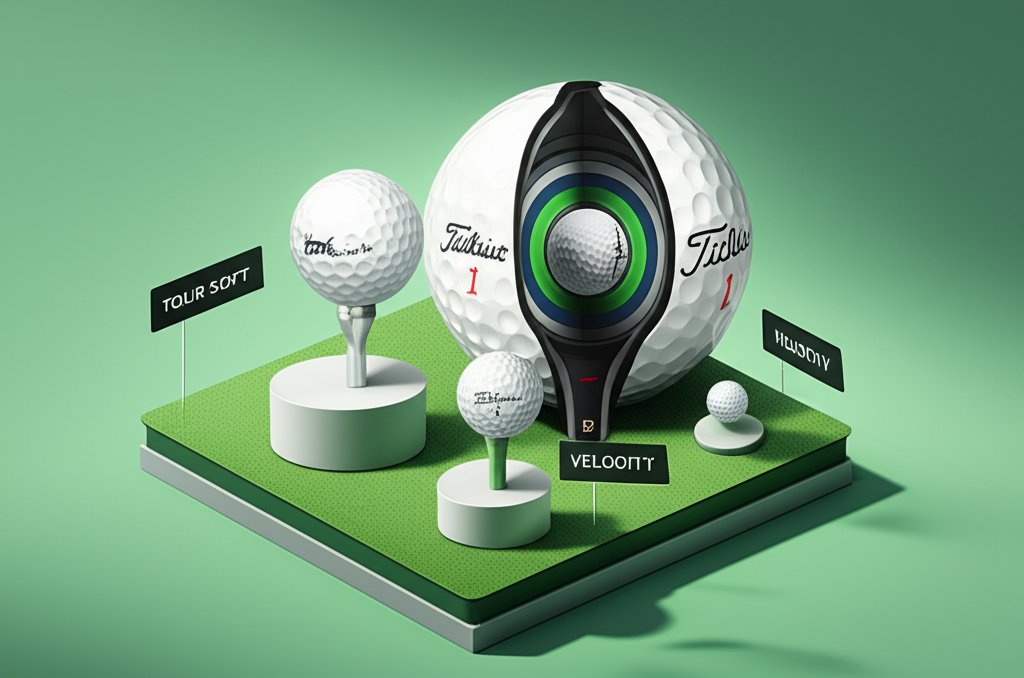
Before we get into model specifics, let’s establish your personal profile. Answer these four questions to get a clear idea of which Titleist family to look at.
- What’s Your Driver Swing Speed? This is the engine. Be honest with yourself.
- Fast (>105 mph): You can fully compress firmer, multi-layer balls. You need to manage spin. Look at Pro V1x, Pro V1x Left Dash.
- Average (85-105 mph): You’re in the sweet spot for many models. Pro V1 is designed for you, but AVX is also a strong contender.
- Moderate to Slow (<85 mph): You need a softer ball with a low-compression core to maximize energy transfer and distance. Tour Soft, AVX, and TruFeel are your primary options.
- What Do You Want From Your Short Game?
- Maximum Spin & Control: You need a ball that grabs the grooves on wedge shots for quick stops. The soft urethane cover on the Pro V1, Pro V1x, and AVX is non-negotiable for this.
- Forgiveness & Simplicity: You’re more concerned with consistent contact and rollout. The durable ionomer covers on Tour Soft, Velocity, and TruFeel are more forgiving and spin less, which can help.
- What Feel Do You Prefer?
- Soft/Muted: If you like a quiet, cushioned feel off the clubface, especially the putter, you’ll love the TruFeel (the softest), Tour Soft, and AVX.
- Firm/Crisp: If you prefer more feedback and an audible “click,” the Pro V1x and Velocity provide that firmer sensation. The Pro V1 sits nicely in the middle.
- What’s Your Typical Ball Flight?
- High Hitter: If you already launch the ball high, you may benefit from a lower-spinning, more penetrating ball like the AVX or Pro V1.
- Low Hitter: If you struggle to get the ball in the air, a higher-launching model like the Pro V1x or Velocity can help you maximize carry distance.
Titleist Golf Balls Review: A Head-to-Head Breakdown
Using data from extensive robotic testing at the Sports Technology Institute at Loughborough University, where 62 different golf ball models were tested, we can move beyond marketing and look at hard numbers. The test used a swing robot and a Foresight GCQuad launch monitor to ensure pure, repeatable data.
The Premium Tour-Level Balls (Urethane Cover)
These are the top-shelf options, featuring a cast urethane cover that provides unrivaled greenside spin and control.
Titleist Pro V1: The All-Around Performer
- Best For: Golfers with 85-100 mph swing speeds seeking a combination of distance, soft feel, and excellent greenside control.
- Profile: The Pro V1 has a softer feel and a more penetrating, mid-range trajectory compared to its “x” sibling. It’s engineered for lower spin off the driver, which helps most players maximize their distance. In robot tests, it delivered a solid 4,598 rpm of backspin with a 7-iron, offering a great blend of distance and stopping power.
- Bottom Line: This is the gold standard for a reason. If you have average to slightly-above-average swing speed and want tour-level performance in every aspect of the game, the Pro V1 is your benchmark.
Titleist Pro V1x: The High-Flight, High-Spin Option
- Best For: Skilled golfers with faster swing speeds (95-105+ mph) who want a higher ball flight and maximum greenside spin.
- Profile: The Pro V1x feels noticeably firmer than the Pro V1. That firmness helps generate more speed and spin, especially for high-speed players. It launches higher and spins more on approach shots, allowing skilled players to attack flags with confidence. Robot testing confirmed its design, showing peak performance at a blistering 114 mph swing speed.
- Bottom Line: Choose the Pro V1x if you have the speed to activate its firm core and want absolute maximum control and stopping power on and around the greens.
Titleist Pro V1x Left Dash: The Low-Spin Speed Demon
- Best For: A niche group of very high-speed, high-spin players who need to reduce spin to gain distance and control.
- Profile: This is a specialized weapon. It’s the fastest, firmest, and lowest-spinning ball in the Pro V1 family. At 114 mph, it was one of only three balls in the entire test to exceed 274 yards of carry distance. However, its performance drops off significantly at average swing speeds. It also produced the lowest spin on 40-yard pitch shots, making it less ideal for players who rely on spin for control.
- Bottom Line: If your pro tells you that you generate “too much spin,” this is your ball. For everyone else, the standard Pro V1 or V1x is a better fit.
Titleist AVX: The Low-Spin, Soft-Feel Premium Alternative
- Best For: Golfers with moderate swing speeds (75-90 mph), including many seniors, who want a premium urethane ball with a softer feel and lower flight.
- Profile: The AVX is engineered to be the opposite of the Pro V1x. It offers a low, penetrating ball flight that is exceptional in windy conditions. It spins less than the Pro V1s on full shots, helping players who fight a slice or want more rollout. Despite being for moderate speeds, it held its own in robot tests, exceeding 271 yards at 114 mph.
- Bottom Line: If you find the Pro V1 launches a bit too high or feels a bit too firm, the AVX is your answer. It delivers premium control around the greens with a softer feel and a piercing flight.
The Performance & Value Balls (Ionomer Cover)
These balls feature more durable covers (often Surlyn or Ionomer) and are designed to optimize performance characteristics like distance or feel at a more accessible price point.
Titleist Tour Soft: The Short Game Specialist
- Best For: Moderate swing speed players and women who prioritize an exceptionally soft feel and need more greenside spin than a typical distance ball.
- Profile: The Tour Soft lives up to its name with a wonderfully soft feel. But its secret weapon is its short-game spin. In the robot test, it was the only two-piece ball to generate more than 6,000 rpm (6,075 rpm) on a 40-yard pitch shot, earning it a gold medal for short-game performance in its category.
- Bottom Line: This ball offers the best greenside spin you can get without paying the premium price for a urethane cover. It’s a game-changer for players who want feel and control.
Titleist Velocity: The Pure Distance Engine
- Best For: Beginners, high-handicappers, and any player on a budget whose number one goal is maximum distance off the tee.
- Profile: The Velocity is a two-piece rocket launcher. Its LSX core is built for speed, and its low-spin characteristics help minimize side-spin on mishits, meaning hooks and slices won’t be as severe. The robot test was staggering: with a 7-iron, it was the lowest spinning (3,081 rpm) and longest (160.6 yards) of all 62 models tested.
- Bottom Line: Straight and long. If you want to simplify the game and hit it farther, the Velocity is an easy and affordable choice.
Titleist TruFeel: The Softest of the Soft
- Best For: Slower swingers, seniors, and mid-to-high handicappers who want the softest possible feel.
- Profile: As Titleist’s softest ball, the TruFeel has an extremely low compression core (around 60-68). This makes it incredibly easy to compress, even at slower swing speeds, helping those players get the most distance out of their swing. While its greenside spin can’t match a urethane ball, its newer, thinner cover provides enough control for most recreational golfers.
- Bottom Line: If a soft, muted feel is your absolute priority, look no further. The TruFeel delivers that sensation with reliable, low-spinning distance.
Your Quick-Start Guide: Matching the Ball to the Player

Let’s simplify this into an actionable cheat sheet. Find your primary goal below to see your top two candidates.
| If Your #1 Priority Is… | Your Best Budget Option Is… | Your Best Premium Option Is… |
|---|---|---|
| Maximum Distance | Velocity | Pro V1x Left Dash (High Speed) |
| Ultimate Greenside Control | Tour Soft | Pro V1 or Pro V1x |
| The Softest Possible Feel | TruFeel | AVX |
| Best All-Around Performance | Tour Soft | Pro V1 |
| Fighting a Slice or Hook | Velocity (Low Spin) | AVX (Low Spin) |
| Playing in Windy Conditions | Velocity (Low Flight) | AVX (Penetrating Flight) |
Common Questions Answered
Q: Can a high-handicapper play a Pro V1?
A: Absolutely, but you might be leaving performance on the table. A Pro V1 requires sufficient swing speed to properly compress the core and unlock its full benefits. A player with a slower swing might actually get more distance, a better feel, and more consistent flight from an AVX or a Tour Soft.
Q: What’s the real difference between a urethane and an ionomer cover?
A: Think of it like tires on a car. Urethane (found on Pro V1, Pro V1x, AVX) is like a soft-compound racing tire—it’s softer and “grips” the clubface grooves aggressively on short shots, creating massive spin and stopping power. Ionomer/Surlyn (Velocity, TruFeel) is like a durable all-season tire—it’s tougher, lasts longer, and spins less, which is great for driver distance but offers less grab on the green.
Q: How much does swing speed really matter?
A: It’s the single most important factor. A fast swing (>105 mph) has enough energy to compress a firm ball like the Pro V1x, unleashing its potential. A slow swing (<85 mph) simply can’t squeeze that same ball, resulting in a hard, “clicky” feel and a loss of distance. That’s precisely why softer, low-compression balls like the TruFeel were invented.
Q: Is a more expensive Titleist ball always better?
A: No. The “better” ball is the one that is best matched to your game. A 20-handicap golfer will likely shoot lower scores with a $30/dozen Velocity that flies straighter than a $55/dozen Pro V1x that spins excessively and exaggerates their slice. Pay for the technology you need.
Putting It All Together: Your Next Step on the Course
A review can only take you so far. The final and most important step is to conduct your own on-course test. Armed with this information, you can stop guessing and start making an educated choice.
Here’s your simple, two-step plan:
- Narrow It Down: Based on your swing speed, feel preference, and performance goals from the guide above, pick two Titleist models to test head-to-head. For example, if you’re a moderate swing speed player torn between feel and spin, your test might be AVX vs. Tour Soft.
- Conduct a Real-World Test: Buy one sleeve of each. Don’t just hit them on the range. Take them to the course.
- On the Green: Start by hitting some 30-foot putts. Which one feels better off the putter face?
- Around the Green: Hit a dozen chip shots with each ball to the same pin. Does one check up faster? Does one roll out more predictably?
- On the Course: Play a few holes alternating which ball you hit off the tee. Observe the difference in trajectory, distance, and how they react when they land on the green.
By the end of this process, the right ball for your game won’t just be a theory from a review—it will be an undeniable feeling and a visible result on the course.

Whether testing new equipment or exploring the world’s best courses, I'm brings fresh, easy-to-understand content that makes golf accessible for everyone. Follow along and elevate your game with expert advice, every day.
- Titleist Golf Balls Review: Which One Best Suits Your Game? - May 29, 2026
- Choosing the Right Titleist Golf Balls Ranked for Performance - May 28, 2026
- Best Titleist Golf Balls for Every Golfer and Swing Speed - May 27, 2026