You hit a perfect drive, flush in the center of the clubface, and it sails beautifully down the fairway. Two holes later, you make an almost identical swing with a different ball you found in the woods, and it balloons into the air, falling 20 yards short. The culprit isn’t your swing; it’s the profound difference between golf balls. This is the single most overlooked piece of equipment in a golfer’s bag, and understanding its technology is a direct path to lower scores.
Choosing the right ball isn’t about finding the “best” one—it’s about finding the best one for you. It’s a piece of gear engineered to complement your swing speed, your feel preferences, and your on-course objectives.
At a Glance: Key Takeaways
- Construction is King: A ball’s layers (from two to five pieces) dictate its core behavior, balancing distance, spin, and control.
- Match Your Motor: Compression rating must be matched to your swing speed to maximize energy transfer and unlock your distance potential.
- Cover Story: The ball’s cover material (soft Urethane vs. durable Surlyn) creates the critical trade-off between greenside spin and long-game forgiveness.
- Flight Dynamics: Dimple patterns are not for show; they are a sophisticated aerodynamic system that controls trajectory, stability, and performance in the wind.
- Test Smart: A data-driven approach, starting with your needs around the green, will lead you to the perfect ball faster than random trial and error.
The Core Difference: How a Golf Ball Is Built
Think of a golf ball like a tiny, high-tech onion. Each layer has a specific job, and the combination of these layers defines how the ball will perform. The fundamental difference between golf balls lies in this construction.
Two-Piece: The Distance Engine
This is the most common and popular construction. It features a single, large solid rubber core encased in a tough, cut-resistant cover. Its design philosophy is simple: maximize energy transfer for speed and minimize spin for straighter flight.
- Who It’s For: Beginners, high-handicappers, and any player whose primary goal is adding distance and hitting more fairways.
- Key Benefit: The low-spinning nature of a two-piece ball reduces the effect of sidespin, meaning your slice or hook will be less severe. They are also the most durable and affordable.
- Example: Models like the Titleist Velocity or TaylorMade Distance+ are built for pure speed and forgiveness.
Three-Piece: The All-Rounder
Stepping up to a three-piece ball introduces a crucial middle layer, known as the mantle, between the core and the cover. This extra layer allows engineers to create more nuanced performance. The core can be optimized for high speed off the driver, while the mantle and a softer cover work together to generate more spin on shorter shots.
- Who It’s For: Mid-handicap players or those with moderate swing speeds who are looking for a blend of performance. You don’t want to sacrifice distance, but you need more feel and stopping power around the greens.
- Key Benefit: A balanced profile that offers good distance off the tee and the higher spin needed to hold greens with irons and wedges.
- Example: The Srixon Q-Star Tour is a classic example of a ball that delivers tour-like feel without requiring tour-level swing speeds.
Multi-Layer (Four & Five-Piece): The Pro’s Choice
These are the pinnacle of golf ball engineering, featuring complex inner cores and multiple mantle layers. Each layer is designed to react differently based on the impact speed.
On a high-speed driver strike, the firm outer layers and soft inner core work to produce high launch and low spin for maximum distance. On a low-speed wedge shot, the soft outer cover is all that’s engaged, creating massive amounts of spin for precision and control. While these layers define the core engineering, they are just one part of the puzzle. To see how these constructions fit into broader performance categories, you can Choose your golf ball type based on your overall game goals.
- Who It’s For: Low-handicappers, scratch golfers, and professionals with faster swing speeds (typically 105+ mph) who can activate all the layers.
- Key Benefit: Total performance optimization. These balls provide the lowest spin with the driver and the highest spin with wedges, offering complete control over every shot.
- Example: The Titleist Pro V1 and TaylorMade TP5 families are the gold standard, offering sophisticated performance for skilled players.
Decoding the Specs: Compression, Covers, and Dimples
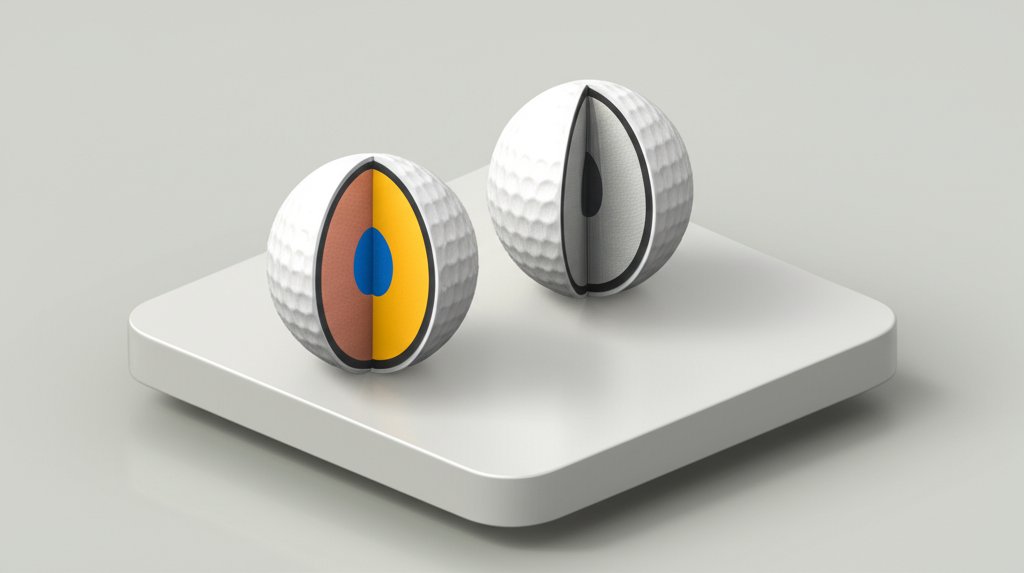
Beyond the number of layers, a few key specifications have a massive impact on how a ball flies and feels. Understanding these will turn you into a much smarter consumer.
Compression: Matching the Engine to Your Swing Speed
Compression is a measure of how much a golf ball deforms against the clubface at impact, rated on a scale from around 40 (very soft) to over 100 (very firm). Think of it like a spring: you need the right amount of force to compress it optimally.
Using a ball with the wrong compression is like putting the wrong fuel in a high-performance car—you simply won’t get the intended results.
| Swing Speed | Golfer Profile | Recommended Compression | Why it Works |
|---|---|---|---|
| Below 90 mph | Most amateurs, seniors, juniors | Low (40-70) | Easier to compress, maximizing energy transfer for more distance. |
| 90-105 mph | Average to good amateurs | Mid (70-90) | A balanced blend of distance off the tee and control with irons. |
| Above 105 mph | Skilled amateurs, pros | High (90+) | Resists deformation, converting elite speed into maximum ball speed. |
| The Pitfall of Mismatching: |
- Slow Swing + High Compression: The ball feels like a rock. You can’t deform it enough, resulting in a significant loss of distance and a harsh feel.
- Fast Swing + Low Compression: The ball feels “mushy.” You over-compress it, leading to a loss of control and potential distance as the energy transfer becomes inefficient.
Cover Material: The Trade-Off Between Spin and Durability
The cover is the ball’s skin. It’s what your clubface actually interacts with, dictating feel and greenside spin.
- Urethane: This is the premium, tour-level material. It’s much softer, allowing the grooves of your wedges and short irons to “bite” into the ball, generating high spin for incredible stopping power on the greens. Think of it like high-performance racing tires—unbeatable grip, but they wear out faster and cost more.
- Surlyn (or Ionomer): This is a much harder and more durable thermoplastic. Because it’s firmer, it spins less—both off the driver (which is good) and off the wedges (which is bad for control). This is your all-season tire: it’s incredibly durable, resists scuffs from cart paths, and helps produce a longer, straighter flight.
A Tale of Two Golfers:
- Anna (5 handicap): She plays a Urethane-covered Titleist Pro V1. She needs the ball to “check up” quickly on firm greens and loves the soft feel for chipping. She accepts that she might lose a ball or two to scuffs during a round.
- Ben (20 handicap): He plays a Surlyn-covered Srixon Soft Feel. His main miss is a slice, so the lower-spinning Surlyn cover helps straighten his ball flight. He also values durability, as his ball occasionally meets a tree or a cart path.
Dimples: The Unsung Heroes of Aerodynamics
A golf ball without dimples would fly erratically and travel less than half the distance. Dimples are a critical aerodynamic feature. They create a thin layer of turbulent air that clings to the ball’s surface, which dramatically reduces the drag (air resistance) behind it.
Simultaneously, the backspin on the ball interacts with this air layer to create lift, helping the ball stay in the air longer for more distance. The shape, depth, and total number of dimples are meticulously engineered to produce a specific ball flight—some are designed for a high, soaring trajectory, while others produce a lower, more penetrating flight for windy conditions.
A Practical Playbook for Choosing Your Ball

Enough theory. Here’s a simple, step-by-step process to find the right ball for your game.
Step 1: Be Honest About Your Swing Speed
This is the most important data point. If you don’t know it, you’re just guessing. The best way is to get measured on a launch monitor at a golf shop or simulator. If that’s not an option, you can estimate: for every 2.5 to 2.7 yards of carry distance with your driver, you have about 1 mph of clubhead speed.
- 200-yard drive? Your swing speed is likely around 75-80 mph. You need a low-compression ball.
- 250-yard drive? You’re in the 95-100 mph range. A mid-compression ball is a great fit.
- 280+ yard drive? You’re swinging over 105 mph and can benefit from high-compression tour balls.
Step 2: Define Your #1 Goal on the Course
What is the one thing you need your golf ball to do better?
- “I need more distance and a straighter flight.”
Your focus should be on Straight Distance or Soft Distance balls. These are typically two-piece, low-compression balls with Surlyn covers. Examples: Callaway Supersoft, Srixon Soft Feel, Titleist Velocity. - “I want a balance of distance and greenside control.”
You are a prime candidate for the Tour Value category. These are often three-piece balls with mid-compression ratings that provide a great all-around package. Examples: Titleist Tour Speed, Srixon Q-Star Tour, TaylorMade Tour Response. - “I need maximum spin, feel, and workability.”
You belong in the Tour Performance category. These are multi-layer, Urethane-covered balls designed for precision and control. Examples: Titleist Pro V1/V1x, TaylorMade TP5/TP5x, Callaway Chrome Soft.
Step 3: Test from the Green Back to the Tee
Most golfers do this backward. They smash a few drivers and make a decision. The best way to test is to start where feel is most important: the putting green.
- Putt & Chip: Buy a sleeve (3 balls) of two or three different models you’re considering. Go to the practice green. The sound and feel off the putter face is critical. If you hate how a ball feels while putting, you’ll never have confidence in it.
- Pitch & Approach: Hit short pitch shots and 50-75 yard wedges. See how the ball reacts. Does it stop quickly? Does it release and roll out?
- Irons & Driver: Finally, take them to the range or the course. The ball that felt best around the greens and still gives you the distance and flight you want off the tee is your winner.
Quick Answers to Common Golf Ball Questions
Q: Does the difference between golf balls really matter for a high-handicapper?
A: Absolutely. It might matter more. A high-spin tour ball will only exaggerate a beginner’s slice and feel harsh on mishits. In contrast, a low-compression, low-spin ball can genuinely help a high-handicapper hit the ball straighter and farther, which builds confidence and makes the game more fun.
Q: Are expensive golf balls always better?
A: “Better” is relative to the player. An expensive multi-layer tour ball is packed with more performance technology, especially for generating greenside spin. However, if your swing speed can’t properly activate all those layers, you’re paying for tech you can’t use. A cheaper two-piece ball might actually perform better for you and save you money.
Q: How often should I change my golf ball during a round?
A: A ball is good to go until it’s lost or has a visible scuff or gouge in the cover. A significant scuff can disrupt the aerodynamics and cause an erratic flight. While tour pros may change balls every few holes to ensure the sharpest possible groove interaction, there’s no performance benefit for amateurs to do so with an undamaged ball.
Q: Do yellow or colored golf balls perform differently than white ones?
A: No. The performance between a white ball and its colored variant (e.g., yellow, orange, matte green) is identical. The color is simply a pigment in the paint or Urethane. It comes down to personal preference and which color is most visible to your eye.
Your Next Step: From Theory to the First Tee
A golf ball is the only piece of equipment you use on every single shot—it’s far too important to be an afterthought. Stop grabbing whatever is on sale or pulling a random logo ball from your bag. Making an informed choice is one of the easiest ways to improve your performance.
Use this quick-start guide to make your next decision:
- Assess Your Speed: Get a real number from a launch monitor or estimate it based on your average driver carry distance.
- Pick Your Priority: Are you chasing Distance & Forgiveness, Balanced Performance, or Maximum Control?
- Buy a Sleeve, Not a Box: Before committing to a dozen, test 2-3 models that fit your profile.
- Trust Your Feel: Start your testing on and around the putting green. The ball that inspires confidence there is often the right choice.
By understanding the key difference between golf balls and matching their design to your game, you can turn a simple commodity into a competitive advantage.

Whether testing new equipment or exploring the world’s best courses, I'm brings fresh, easy-to-understand content that makes golf accessible for everyone. Follow along and elevate your game with expert advice, every day.
- Difference Between Golf Balls to Optimize Your Performance - May 23, 2026
- Different Types of Golf Balls and How to Choose Yours - May 22, 2026
- Types of Golf Balls that Fit Your Game - May 21, 2026